
Custom Folding Cartons
Custom folding cartons for retail products.
Create printed paperboard cartons for bottles, tubes, small products and retail packs. We help you choose a closure, material and finish, check product fit with a sample and arrange flat or assembled supply for your order.
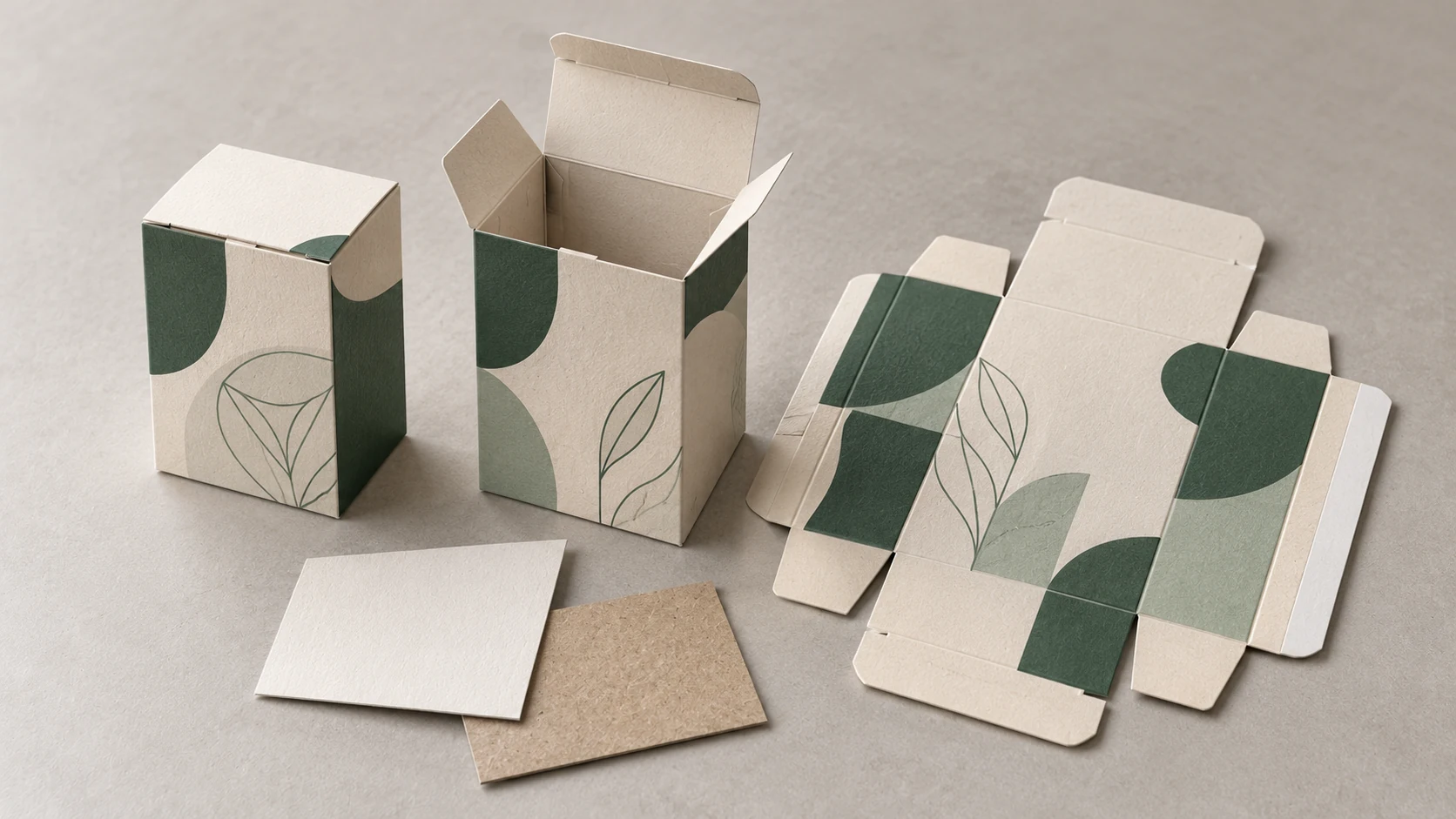
Start with the product and packing line
A carton that looks right on a shelf can still be hard to fill, weak at a closure, or too tight around an insert. Record the product’s maximum dimensions and weight, its intended orientation, the opening direction, and any accessories before selecting a tuck, lock, sleeve, or other structure.
Folding cartons are often one layer of a larger packaging system. A fragile or heavy product may need an insert, cushioning, or a separate corrugated shipper. Decide which layer provides presentation and which layer is responsible for transport protection.
Retail presentation
Useful when printed panels, product information, shelf orientation, and a consistent opening matter. Confirm the finished panel layout and required legal or barcode copy.
Flat storage
A carton supplied flat can reduce empty-package volume. Check assembly time, locking or gluing steps, and how finished units will be packed.
Fit and restraint
Measure the actual packed item, including caps, bags, manuals, and inserts. Confirm clearance, movement, removal, and closure with a structural sample.
Transport boundary
Do not assume a retail carton alone is a parcel shipper. Review the packed product and handling route before deciding on outer protection.
Where this box sits in the packaging system
Read from the outer layer toward the packed product. Each layer is reviewed against the product and delivery route.
Structure at a glance
Structure, material, and finish options
Use these options to start a project discussion. The workable combination is confirmed against your product, quantity, artwork, and delivery needs.
Available materials, structures and finishes depend on your product and order. We confirm the workable combination, price and schedule in your quotation.
Order size, samples, and production planning
How your order takes shape
Brief
Share product size and weight, quantity, destination, artwork status, and reference packaging.
Structure
Compare a suitable closure, board direction, insert, print, and packing method.
Approve
Check dieline, fit, artwork, material and finish references with the appropriate proof or sample.
Release
Record the approved specification, inspection points, packing, and delivery responsibility.
Frequently asked questions
What is the minimum order for folding cartons?
A run of 10 folding cartons can be arranged for suitable configurations, but the unit price is very high at that quantity. Board, size, printing, finishing, and setup determine the quote. Larger print quantities generally reduce the unit price.
Can I ask for a quote without a dieline?
Yes. Send the product dimensions, weight, quantity, destination, and a reference image or sketch. The structure and artwork responsibilities can then be discussed before a production-ready dieline is approved.
Can a folding carton replace a shipping box?
That depends on the product and route. Printed retail surfaces can be damaged by parcel labels and handling, and a fragile item may need an insert or an outer shipper.
How long will sampling and production take?
Sample type, revisions, material, finish, quantity, and approval conditions change timing. Request a schedule that separates sample approval, production, and transport.
Start with the details you know
Tell us what you need to pack, your estimated quantity and destination. Add known dimensions and any artwork or reference packaging. If a detail is undecided, write “Not sure”; we will help identify what is needed for a quote or sample.
Related planning guides
Back to all packaging families · Design preparation
For beauty and personal-care projects, review the cosmetics packaging planning guide.